
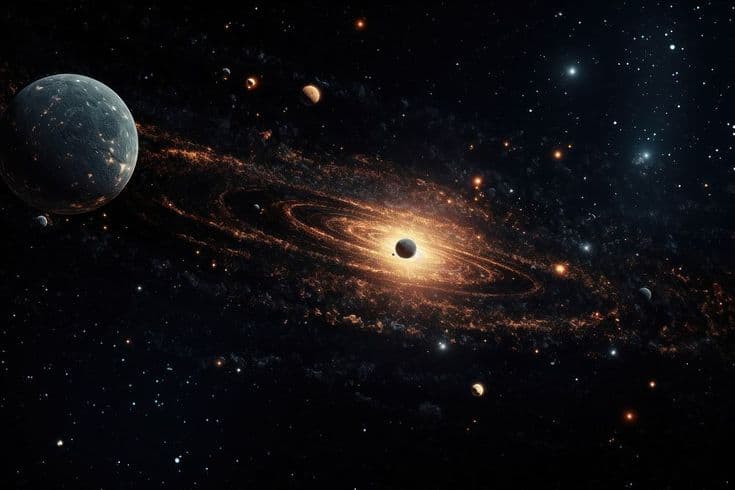
Astronomy is one of the oldest natural sciences, and early civilizations in recorded history made systematic observations of the night sky.
Astronomy is the study of celestial phenomena and objects. It uses mathematics, physics, and chemistry to explain the origin and evolution of these phenomena and objects. Objects of interest include planets, moons, stars, nebulae, galaxies, and comets. Related phenomena include supernova explosions, gamma-ray bursts, quasars, luminosities, pulsars (distinct from pulsars), and the cosmic microwave background radiation. In general, astronomy studies everything that originates outside Earth's atmosphere. Cosmology is a branch of astronomy that studies the universe as a whole.
Astronomy is one of the oldest natural sciences, and early civilizations in recorded history made systematic observations of the night sky. These included the Babylonians, Greeks, Indians, Egyptians, Chinese, Mayans, and many indigenous peoples of the Americas. In the past, astronomy encompassed diverse disciplines such as astrometry, celestial navigation, observational astronomy, and calendar making. Currently, professional astronomy is often considered synonymous with astrophysics.
Modern astronomy is divided into two branches: theoretical astronomy and observational astronomy. Observational astronomy focuses on obtaining data from observations of celestial objects. This data is then analyzed using the fundamental principles of physics. Theoretical astronomy is geared towards developing computational or analytical models to describe celestial phenomena and objects. These two fields complement each other. Theoretical astronomy seeks to explain observational results, and observations are used to confirm theoretical findings.
Amateur astronomers have contributed to many important discoveries. Astronomy is one of the few sciences in which amateurs can play a significant role, especially in discovering and observing transient phenomena.
The United Nations declared 2009 the International Year of Astronomy (IYA2009), aiming to promote public awareness and engagement with astronomy.
Origin of the Name
In Arabic, the word for knowledge (ʿilm) is the opposite of ignorance (jahl). The celestial sphere (falak) is the orbit of the stars, and its plural is aflak. Al-Fayruzabadi, in his dictionary Al-Muhit, also pluralizes it as fuluk. The Al-Wasit Dictionary states that the celestial sphere is the orbit in which a celestial body moves, and that the science of astronomy is the study of celestial bodies and their conditions, and that an astronomer is one who practices this science.
The science of astronomy (in English) is called Astronomy, a word composed of two parts: the prefix Astro-, meaning star, sky, or astronomer, and the suffix onomy, meaning the set of rules or laws governing knowledge in a field of human knowledge.
The science of astronomy (in Greek) is called ἀστρονομία, a word composed of two parts: ἀστρο, meaning star, and νόμος, meaning law. Thus, the literal meaning of the word is "the law of the stars." Astronomy should not be confused with astrology; astrology is the claim that human affairs are linked to the positions of celestial bodies. Although the two fields share a common origin, they are now quite distinct.